


Deposit, scale, freezer
How buying a share works
You are buying part of one animal, priced by what it weighs. That means two payments to us instead of one, and a bill from the butcher that is not ours. Here is the whole of it, in order, with the figures.
Which size are you thinking about?
Everything below updates as you choose.
Not sure? Work it out with us.Four questions about your table. Nothing is sent anywhere.
What we would point you at
Half Beef
Four of you, beef three or four nights a week — call it 220 lbs of beef a year. A Half Beef comes home at about 220 lbs.
Two different weights
You pay on the hanging weight. You eat the take-home weight. But what comes back to you in boxes depends on how you have it cut — the bones are yours to keep, and a sheet that keeps them for stock and bone-in roasts sends more weight home than one that does not. The carcass also loses moisture hanging in the cooler, whatever you ask for.
What it costs
- What you pay today$500Your deposit. It holds an animal in your name, and it is all that is charged now.
- Balance, after the scaleest. $2050.00 – $2730.00Billed off the real hanging weight once the butcher has the carcass on the rail.
- The beef, all in, to usest. $2550.00 – $3230.00
- Cut and wrapCut-and-wrap is paid to the butcher, not to us. None of the figures above include it — around here it runs $1.00 to $1.50 a pound of hanging weight, but ask your processor for their own rate and their kill fee.
- Both bills togetherOurs and the processor’s, added up. You will write two cheques, not one.
What a pound actually costs you
$13.14for every pound of beef
that ends up in your freezer
And this one does not move with the animal. A heavier steer means more beef and a bigger bill in the same proportion — what a pound of beef costs you stays put.
a pound once the processor is paid too.
Room to put it
5.5 – 7.3 cu ftof freezer, packed
Fits in a standard 7 cu ft chest freezer.
That sits inside the 7 cu ft you have, with about 0.7 cu ft left over.
About 12 months of eating for the four of you.
Answer these and the size above moves to match — along with every figure on the rest of the page. Pick a size yourself at any point and we will stop guessing and show you that one.
Now showing Half Beef: $500 today, about $2050.00 – $2730.00 after the scale, and roughly 220 lbs of beef.
Our most popular share. Fills a standard chest freezer.
What you pay, and when
Today
$500
to the ranch
Your deposit. It reserves an animal and comes off the final bill in full.
After the scale
$2050.00 – $2730.00
to the ranch
The balance, worked out from the real hanging weight at $8.50 a pound. An estimate until the animal is weighed.
At the butcher
$300.00 – $570.00
to the processor
Cut and wrap, around $1.00 to $1.50 a pound of hanging weight. Paid to them, not to us — ask for their rate and their kill fee.
Only the first two are ours. The butcher bills you directly for cutting and wrapping, and we will walk you through the cut sheet before you ever speak to them.
Start to freezer
- 1
today
Put a deposit down
$500 reserves a half for you and takes it off the shelf. That is everything you pay today — the rest waits on a weight nobody has yet.
$500to the ranch
- 2
a week or two before harvest
The butcher rings you about cuts
You choose steak thickness, roast size, and how much of it goes to ground. It is a ten-minute phone call and we walk you through the sheet beforehand, so none of it is a surprise.
- 3
harvest day
Harvest day, and the scale
The carcass is weighed on the rail at the processor. Your share hangs at about 300–380 lbs, and that number — not an estimate — is what your bill is built from.
- 4
within a few days of the scale
We bill the balance
$8.50 a pound of hanging weight, less the $500 you already paid. We ring you with the weight first, so you hear the figure from a person before you get an invoice.
$2050.00 – $2730.00to the ranch
- 5
10 to 15 days after harvest
Collect it, frozen and wrapped
About 220 lbs of beef, boxed and labelled. Bring two large coolers. Cut and wrap is settled with the processor when you collect.
$300.00 – $570.00to the processor
Will it fit?
About 220 lbs of beef in your freezer, from 300–380 lbs hanging.
6.3 cu ft of freezer space. Fits in a standard 7 cu ft chest freezer.
Two large coolers on pickup day.


What nobody explains until pickup day
None of this is complicated, and none of it is a catch. It just tends to go unsaid until pickup day, which is the worst possible time to hear it for the first time — so here it is, before you order, along with the straight answers to what people ask us about how the animal was raised.
What you are buying, and what it costs
Hanging weight against take-home weight
A share is priced per pound of hanging weight — the carcass on the rail at the butcher’s, bone and fat and all, before a single cut is made. It is the only weight that exists at the moment you pay, which is why it is the one the price is set against.
Take-home weight is what you carry out in boxes: after the fat is trimmed and the carcass has hung in the cooler long enough to age, which costs it moisture. How much of it comes home is partly your own decision — the bones are yours if you want them, and a sheet that keeps them for stock and bone-in roasts weighs more than one that does not. On a typical sheet about 65% of the rail weight comes home with you.
So a bill that looks like it is for more beef than you received is almost always correct, and almost always explained by this one paragraph.
Why cut-and-wrap is not on our bill
We raise the animal. A licensed processor kills it, hangs it, and cuts it to the sheet you fill in — steak thickness, roast size, how much goes to ground. They bill you for that work directly, and we never see the money.
It is usually charged per pound of hanging weight, with a flat kill fee on top, and around here the rate runs $1.00 to $1.50 a pound. Ring them and ask for both figures. If you put their rate into the worksheet above, we will add it up for you and keep it in its own column, where it belongs.
What the deposit is, and is not
Your deposit reserves an animal in your name. That is all you are charged today, and it counts toward the total — it is not a fee.
On harvest day the butcher weighs the carcass on the rail. We bill the balance off that real number, before pickup. Until then every total anybody quotes you, on this page or anywhere else, is an estimate, and we will keep saying so.
Fulfilment is ranch pickup or local delivery. We do not ship beef.
Whether it beats the grocery store
It does, and the sticker is the only reason anybody doubts it. A share is one large number paid twice; the grocery store is a hundred small ones spread over a year, which is a far more comfortable way to spend more money. Line the same cuts up side by side — the steaks, the roasts, the ribs, the ground — and buying them direct from the rancher comes in well under buying every one of them at retail.
You also get more than the meat case is willing to sell you. Soup bones for bone broth. The fat, if you want to render your own tallow. The big bones held back for the dog. The organs, if you would like them — some people freeze-dry them. None of that is an extra. It is your animal, and it is all on the cut sheet.
The last column of the table below is what a pound of beef in your freezer works out at, so you can hold it against whatever you paid last time.
How much freezer you need
Boxed beef packs at somewhere between 30 and 40 pounds per cubic foot. The spread is real: a box that is mostly one-pound packs of ground stacks flat and dense, and one with bone-in roasts, ribs and a whole brisket in it does not.
A quarter beef wants 2.8 to 3.7 cu ft — a standard chest freezer, near enough, and the reason so many families end up with one in the garage.
Bring coolers on pickup day. Beef comes out of the processor frozen hard and you want it to stay that way on the drive home.
Splitting a share with somebody else
Plenty of people do. One person places the order, pays, and collects; how you divide it afterwards is between you, and the butcher packs it as one share either way.
If you would each rather have your own order, your own boxes and your own cut list, buy two smaller shares instead. That is what the eighth is for — it is the size that used to only exist by splitting a quarter with a friend.
If you do not like the beef
We will buy it back from you. Not a credit, not a partial, not an argument — if the beef is not what you hoped for, we would rather have it back than have you eat a year of something you do not enjoy.
Two fair conditions, and they are the only two. Tell us early, please, rather than at the last steak — if there is roughly 90% of your meat left and you are not satisfied, we will buy it back. And the original deposit is not refundable, because it reserved and held an animal in your name that nobody else could buy.
Ring us. This is a conversation, not a claims process.
How the animal was raised
Hormones — we do not use them
All of our beef is 100% hormone free. No growth implants, nothing hormonal in the feed, at no point in the animal’s life.
There is no version of this that applies to some animals and not others. It is how the herd is run.
Antibiotics — yes, and no
Yes and no, and the honest answer is worth the paragraph. A good rancher treats every animal individually and as needed, and on our place we believe an ounce of prevention is worth a pound of cure. So most of the work goes in long before anything is wrong: a strong vitamin and mineral routine, a balanced diet, clean water, maintained facilities, and a lot of garlic in the ration, which is a natural antibiotic.
Even so, the cold comes and now and then a calf gets sick. We try homeopathic remedies first. If those are not working, we intervene — penicillin, or Nuflor for a respiratory infection — because standing over a sick animal to protect a label is not something we are willing to do.
Any animal we treat is marked, and it leaves through the local sales barn.It is not kept back for our farm-to-table beef. So: yes, we use antibiotics responsibly, when an animal needs them. And no — we will never sell you an animal that has been treated.
Grass fed, grain supplemented
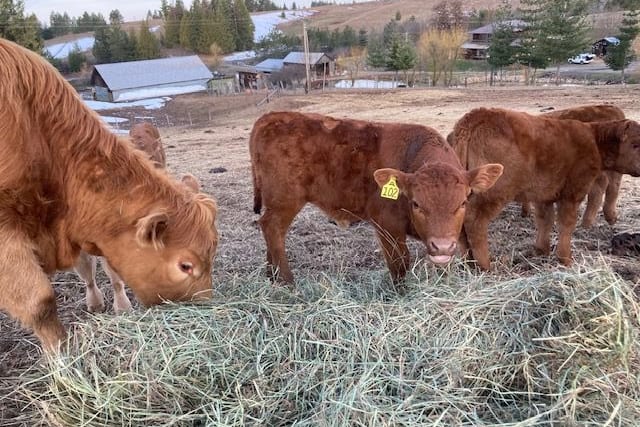
Primarily grass. Cattle are ruminants, built to digest it — turning grass into a good steak is their superpower, and we would rather not argue with it.
Every year we plant a diverse cover crop: peas, oats, sunflowers, radishes and sorghum. When the cattle come home from summer pasture in the fall they are turned out onto that leafy plantation. Then, as they near butcher time, they go onto the hay pasture and we supplement with grain — a barley, corn and oat mix, locally sourced and non-GMO, because local grain is the best grain we can put in front of them.
Which is why we call it grass fed and grain supplemented, and say both halves out loud. The grass is what the animal was raised on; the grain at the end is what makes it more tender, and what you taste.
| Share | Rate | Hanging weight | Beef you take home | Freezer space | Deposit today | Per lb of beef |
|---|---|---|---|---|---|---|
| Eighth Beef | $9.00/lb hanging | 75–95 lbs | 49–61 lbs | 1.4–1.8 cu ft | $150 | $13.91 |
| Quarter Beef | $8.75/lb hanging | 150–190 lbs | 97–123 lbs | 2.8–3.7 cu ft | $250 | $13.52 |
| Half Beef | $8.50/lb hanging | 300–380 lbs | 194–246 lbs | 5.5–7.3 cu ft | $500 | $13.14 |
| Whole Beef | $8.00/lb hanging | 600–760 lbs | 388–492 lbs | 11–14.7 cu ft | $1000 | $12.36 |
Collecting it
Pickup is at the ranch in Kamiah, Idaho. Come during ranch store hours, or call ahead and we will set a time that works. Bring coolers or boxes: a quarter beef fills one large cooler and a half fills two. Call 208-507-0766 when you are on your way.
Rather just ask someone?
A page cannot look at your freezer. Ring the ranch and we will talk it through — how many of you there are, what you actually cook, and whether an eighth or a half is the sensible start.
208-507-0766