A cut sheet is the one-page form that tells the butcher how to turn your beef into the packages you will actually open. It looks intimidating and it is not. There are nine real decisions on it, and there is a sensible answer to every one.
Cut-and-wrap is billed by the processor, not by us. It is separate from what you pay the ranch, and it is never folded into a ranch total anywhere on this site.
Every animal is different.
Yields vary. Any weight on this page is an estimate until the carcass is on the scale, and it is labelled as one every time.
You can hand it back to us.
Say “the house sheet” and we will fill it in for you. Most first-timers do, and most of them keep doing it. This page prints cleanly if you would rather take it with you.
What most people pick
If you’d rather we just handled it.
Steaks an inch thick and two to a pack, roasts around three pounds, ribs and brisket left whole, a couple of packages of stew meat, and everything else ground into one-pound packs — no organs, no sausage. That is the house sheet, and it is one sentence long because it needs to be.
Steaks
cut the way our ribeye steaks are cut — “Two per pack, cut one inch thick.” — about 10 oz a steak, 1.25 lbs to a pack.
Roasts
around 3 lbs apiece, the size of the chuck roast on our shelf. 6 to 8 of them on a half.
Ribs and brisket
left whole — a packer brisket runs about 13 lbs, short ribs cut English style.
Stew meat
two or three packages, and the rest of that trim goes to ground.
Ground
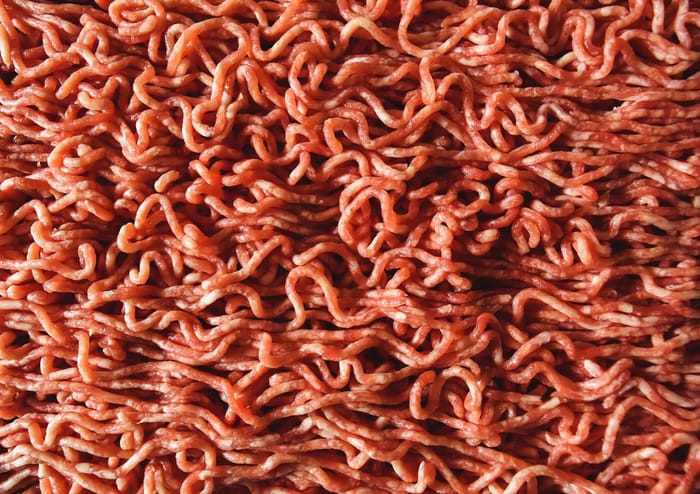
everything else, in 1 lb packs, ground to 90/10 — the same as what we pack for the shelf.
Bones
a 5 lb bag if you want them — say so on the sheet, they are not automatic.
Organs and sausage
skipped, unless you tell us otherwise. Most first-timers skip both.
None of that is a description written from memory. It is how the cuts on our own shelf are already cut, read straight out of the shop — so if you have bought a steak from us, you have already seen what a house sheet produces.
Ask us what our processor calls their own standard sheet — it is close to this, and we will tell you where it differs.
Or take the nine decisions yourself — they’re worth twenty minutes, and they are the difference between a freezer you cook out of and a freezer you dig through.
Take them in order. Each one says what the choice actually means, what most families pick, and what you would be giving up by choosing something else. Nothing here is a wrong answer — they are just different freezers.
01
How thick do you want the steaks?
Thickness changes how a steak cooks more than anything else you will do to it. A thin steak has to go in a very hot pan and come straight back out, or it is grey through the middle before the outside has browned. A thick steak gives you time: you can build a proper crust and still stop at medium rare, because the heat has further to travel.
¾ inch
Hot and fast. In the pan, out, on the plate.
1 inch
The all-rounder. Takes a sear and forgives a minute.
1¼ inch
Grill or reverse-sear. Room to be a little wrong.
1½ inch
One steak, two people. Bring a thermometer.
Drawn to relative scale, not to life size — a screen has no way of knowing how big it is. What is true is the ladder: a 1½ inch steak is twice the steak a ¾ inch one is.
What most families pick
The shelf default. Our ribeye steaks are described as “Two per pack, cut one inch thick.”, and that is the thickness that forgives the most — hot pan, cool pan, distracted cook, it still comes out.
What you give up
Thinner, and you need a screaming pan and your full attention; there is no margin between rare and ruined. Thicker, and you need a thermometer and a rest, and one pack stops being one person’s supper and starts being two people’s.
02
How many steaks to a package?
This is a question about your kitchen, not about beef. A package comes out of the freezer whole and it does not go back in. So count the people at your table who eat steak on an ordinary Tuesday, and write that number in the box.
Ribeye Steaks1.25 lbs a pack · about 10 oz a steak
New York Strip1.1 lbs a pack · about 9 oz a steak
Two in a pack, one supper, nothing left thawing on the side.
What most families pick
Two to a pack. It suits a couple exactly, and it suits a family of four who open two packs of two different steaks — which is how most people actually eat a share, rather than four identical ribeyes in a row.
What you give up
Four to a pack means thawing four when you wanted two. Singles mean twice the paper, more bulk in the freezer and a great many more packages to label — and some processors charge by the package, so it is not always free.
03
Roasts: how big, and how many?
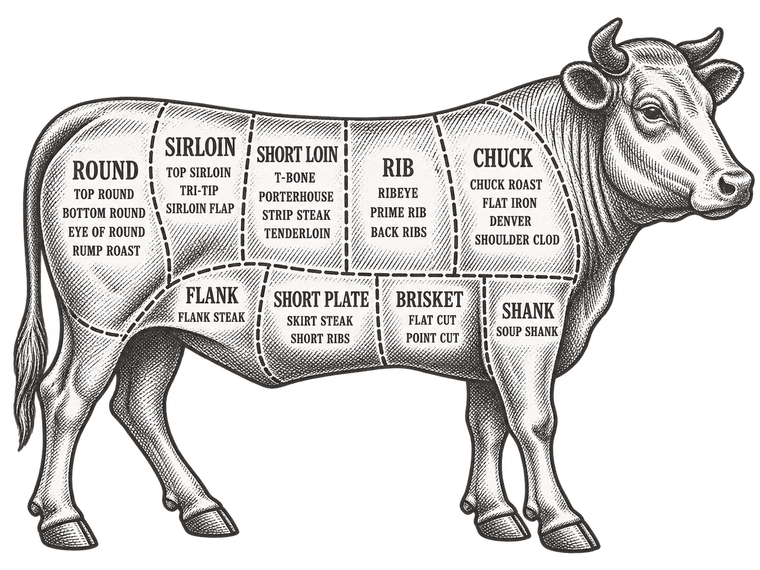
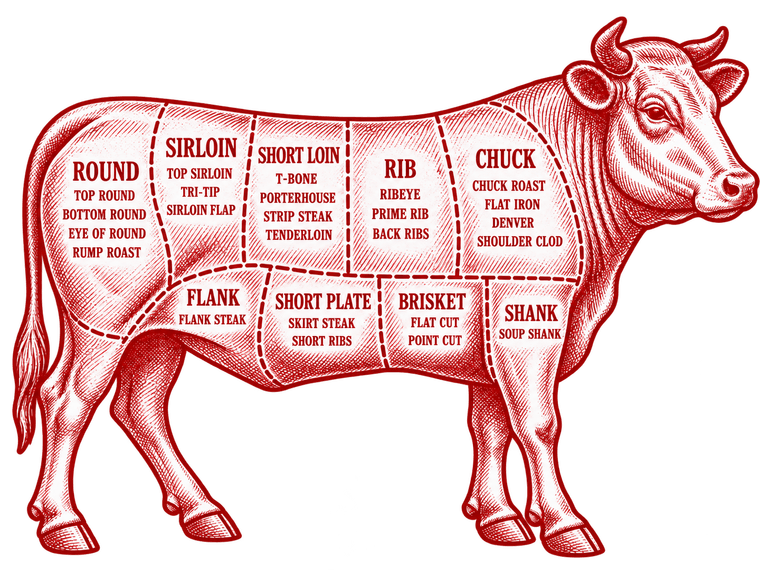
Roasts come off the chuck, the round and the sirloin tip. A roast is the one cut that rewards a long slow afternoon and asks almost nothing of you while it happens — and it is the cut most often ground up by people who were not sure what to do with it. The chuck roast on our shelf is the size most people ask for: “Three pounds. Sunday dinner, sliced thin for sandwiches Monday.”
1 roast at 3 lbs is exactly the same beef as =3 packs of ground at 1 lb
What most families pick
6 to 8 roasts on a half beef, around 3 lbs each. At the top of that range it is 24 lbs of the roughly 220 lbs that comes home — about 11% of your beef, for a cut you will cook on the coldest eight days of the year.
What you give up
Ask for fewer or smaller and those pounds do not vanish, they go to ground. Ask for a lot of big ones and you are cooking for a crowd you may not have — a five-pound roast for two people is four days of the same sandwich.
04
How much of it goes to ground?
Ground beef is where everything goes that is not a steak, a roast or a rib — and it is also where the pounds land every time you say no to something else on the sheet. This is the one line that quietly settles most of the others, which is why it is worth answering last even though it is printed in the middle.
To put a size on it: a half beef comes home as roughly 220 lbs of beef. If you took nothing but ground, that is about 220 packs at 1 lb apiece — an estimate, like every weight on this site, until the animal is on the scale.
The pile everything else falls into.
What most families pick
Take the steaks and roasts you will genuinely cook, then let the rest go to ground. For most households it ends up the single biggest share of the animal, and nobody has ever rung us to say they had too much ground beef.
What you give up
More ground means fewer roasts, less stew meat and a shorter steak list. It is not extra beef — it is the same beef, minced. The pounds are fixed on harvest day; the sheet only decides their shape.
05
How lean do you want the ground?
The processor grinds trim back into the beef to hit a fat ratio, and the sheet asks you which one. Leaner is not better, it is drier. Fattier is not worse, but it shrinks more in the pan and leaves grease to pour off.
What most families pick
90/10 — what we pack as Ground Beef 90/10 for the shelf. It browns without swimming, and it still makes a burger that holds together on a grill grate.
What you give up
Go leaner and your burgers dry out; you will end up adding fat back at the stove. Go fattier and the burgers are better, but chili and tacos need draining — and you paid the hanging-weight rate for fat you are pouring down the sink.
06
Stew meat, or more ground?
Stew meat is beef cut into cubes from the same trim that would otherwise have gone through the grinder. It is not a different part of the animal — it is a different decision about the same part, made with a knife instead of a plate.
On the form it usually looks about like this:
Stew meat
none
2–3 packages
as much as it makes
What most families pick
Two or three packages. That is a pot of stew and a batch of chili a few times over a winter, which is about as often as anybody really makes either.
What you give up
Take a lot and you will find yourself cubing it smaller anyway for most recipes. Take none and you can still make stew — you will just be cutting up a chuck roast to do it, which is exactly what stew meat was in the first place.
07
Bones, marrow and fat.
These come out of the animal either way. The only question the sheet is asking is whether they go home with you or into the barrel. Three separate boxes, and they are not the same thing:
Soup bones — knuckle and neck, sawn into pieces. We sell them by the 5 lb bag. Roast them before you simmer them; that is the difference between stock and grey water.
Marrow bones — leg bones, and you have to say split lengthwise or you will get rounds, which are harder to get at.
Suet and fat — for rendering into tallow. Ask for it in blocks rather than ground, or you will be picking it out of a bag of crumbs.
What most families pick
A bag of soup bones and a few split marrow bones. They are the cheapest thing that will ever be in your freezer and they are the entire difference between water and stock.
What you give up
Real freezer room — bones are bulky and light for their size — and possibly a line on the processor’s bill, since cutting and wrapping them is work like anything else. Say no and you have lost nothing you would have eaten.
Ask us whether there is a charge to cut and wrap bones and fat — it depends on the processor and we will not quote theirs for them.
08
Heart, liver, tongue, oxtail.
They are all on the sheet, and most people tick none of them. That is a perfectly good answer — nobody behind the counter thinks any less of you for it, and it is what the majority of first-time sheets say.
If you are curious, the two that convert people are the heart, which tastes like very good steak and cooks like one, and the oxtail, which makes one of the best braises on the animal. There is only ever one tail. The catch is that you have to ask now: unticked boxes are discarded, and you cannot ring up a fortnight later and ask for the liver back.
On the form it usually looks about like this:
Organ meats
heart
liver
tongue
kidney
oxtail
none
What most families pick
None. If you want to try, tick the heart and the oxtail and leave the rest — two small packages is a fair experiment, and neither of them takes much room.
What you give up
Nothing at all, if you were never going to cook them. The oxtail is the only one worth a second thought, because there is one per animal and the next one is a year away.
09
Sausage, cure and smoke.
Breakfast sausage, brats, summer sausage, snack sticks, jerky, and a bacon-style cure on the belly. All of it is beef you already own, taken a step further — and a step further is labour, so it is charged per pound, on top of cut-and-wrap. Cured and smoked items sometimes go out to a second shop as well, which adds time before you can collect.
On the form it usually looks about like this:
Sausage
breakfast
brats
summer sausage
snack sticks
jerky
none
What most families pick
Most first-timers skip it, buy a few packs of brats somewhere to find out whether their household eats them, and decide next year. That is the cheap way to learn whether you want twenty pounds of it in a freezer.
What you give up
The per-pound charge and the wait — and every pound that becomes sausage is a pound that does not come back as ground beef. If you love brats, that is a good trade. If you are guessing, it is an expensive one.
Ask us about sausage, cure and smoking — what it costs a pound, what is done in house, and how much longer it adds. Ring before you send the sheet.
Your rate does not move with your sheet.
A share is priced per pound of hanging weight, and hanging weight is settled on the rail on harvest day — before a single one of these nine choices is made. Nothing on the cut sheet changes what you pay the ranch. What it changes is what those pounds look like when you open the freezer door.
Quarter Beef
A freezer starter. Roughly a third of a chest freezer.
$4.45per pound of hanging weight
On the rail
150 – 190 lbs
In the freezer
about 110 lbs
Deposit today
$250
est. $6.88 a pound of beef in the freezer — the estimated share total divided by the beef it is expected to yield. Before cut-and-wrap, which you pay the processor.
For scale: about 110 packs of ground at 1 lb apiece, or 37 roasts at 3 lbs apiece — if you took nothing else.
Half Beef
Our most popular share. Fills a standard chest freezer.
$4.25per pound of hanging weight
On the rail
300 – 380 lbs
In the freezer
about 220 lbs
Deposit today
$500
est. $6.57 a pound of beef in the freezer — the estimated share total divided by the beef it is expected to yield. Before cut-and-wrap, which you pay the processor.
For scale: about 220 packs of ground at 1 lb apiece, or 73 roasts at 3 lbs apiece — if you took nothing else.
Whole Beef
The best price per pound we offer. Split it with family.
$4.10per pound of hanging weight
On the rail
600 – 760 lbs
In the freezer
about 440 lbs
Deposit today
$1000
est. $6.34 a pound of beef in the freezer — the estimated share total divided by the beef it is expected to yield. Before cut-and-wrap, which you pay the processor.
For scale: about 440 packs of ground at 1 lb apiece, or 147 roasts at 3 lbs apiece — if you took nothing else.
Hanging weight is not freezer weight.
The difference is bone, trim, and the moisture an animal loses while it hangs. A half beef that weighs about 340 lbs on the rail comes home as roughly 220 lbs in boxes. Both of those are estimates until the scale says otherwise — and the gap between them is exactly why the cut sheet is worth twenty minutes. The same carcass can come home as very different beef.
It is also why the sheet is worth thinking about rather than waving through. Off our own shelf, ribeye steaks are $27.20 a pound and ground beef 90/10 is $9.50. In a share you pay one rate for all of it, whichever way you have it cut.
Who you pay, and when.
There are two bills and they come from two places. Getting that straight before harvest day is most of what makes the process feel simple afterwards.
1
A deposit, to us.
$250 to $1000 depending on the size of the share. It reserves an animal and it is all you pay today.
2
The balance, to us, after the scale.
On harvest day the carcass is weighed on the rail. We bill the balance off that real number, at the rate on your share — never off an estimate.
3
Cut-and-wrap, to the processor.
A separate bill, from a separate business, usually charged by the hanging pound. It is not included in anything you have paid the ranch, and it is not in any figure on this page.
Four things to ring us about
We will not print a processor’s prices or policies on their behalf, so you will not find them on this page. Ring the ranch and we will tell you what we know today.
Who cuts for us, and which town they are in
What they charge to cut and wrap, and what that is charged on
When your sheet is due, and whether they will take it by phone
How long it is from harvest day to your pickup
Still not sure about any of it? Ring the ranch and we will go through the sheet with you line by line. It takes about ten minutes and it is the part of this we enjoy.